Sunday, January 11, 2015

Um....... are you sure this is where we should be.......?

I am pretty near the end of my trip now, (thank goodness I hear you say.....)

We are home late, and I am leaving Yemima the next morning as I am going to be spending the day with Clara and then going back to Shoshi. You may remember that at the very start of this trip, I met Linda Bar-On and she had told us that she was going be having an exhibition in Be'ersheva on the 18th November and I was delighted as I would still be there to see it.

Clara called to say she was almost with us, and Yemima and I went down to meet her, me clutching my little bag, and we then loaded it into the back of Clara's car. As I cam out of the door she said as it looked as if I as making aliyah! Well, maybe I should......... and after saying my goodbyes to Yemima,  we left.

Clara told me that as we were heading for Be'ersheva, she wanted to take me to a museum on the way down. We were heading south again and the countryside was desert with some greenery. We were heading to the Joe Alon Centre. This houses the museum of Bedouin Culture.

Joe was a very interesting man, he was sent to England at the outbreak of WWII and when he returned to Czechoslovakia, he found his parents had been victims of the Holocaust. He enlisted into the Israeli airforce while in Czechoslovakia and progressed from there. He was Air Attache in Washington DC, and was murdered a month before he was due to end his term of office in 1973.

There is a display in the foyer of the museum showing his ribbons.


We moved outside and there was a Bedouin tent set up. As you can see they are not particularly small. The Bedouin life is a nomadic one, and they would move around the desert. There are several Bedouin tribes in the Sinai and the Negev.


The tents are very interesting as they are made of goat hair which repels water so is completely waterproof. The area in the photograph would be for entertaining. The other side of the striped fabric would be where the women baked and cooked and brought up the children and is known as the "Shigg". There was a lady baking bread which was typical of their culture and she invited us to break some off and eat, it was lovely, still hot and was flat and thin unlike Pita bread which is small and puffy.


We then moved into the Museum where there was a short film which explained the lifestyle, if a stranger arrived, he would be entertained in the main part of the tent and the women would provide food and make sure that he was welcomed, but the men would be the ones to entertain. The museum was well laid out and we had a lovely time looking at all the weavings, jewellery and other items there.


Bedouin beading and weaving


Blankets and wall hangings


Bridal attire


The camels have beautiful saddle covers


It was time for us to leave and head towards Be'ersheva. We were meeting a couple of Clara's friends, Nina and Ziva for lunch, they had been part of the committee choosing the quilts to come to Canada, and are both members of the guild in Be'ersheva.

But first, we had time to go to Lakia. This is a town which has been built to house the Bedouin, so there are not to many that now travel around the desert. Our first stop was at the Desert Weaving to see the beautiful cushion covers, bags and rugs that are made there, they were lovely but my goodness, they were heavy. We were allowed to wander around to the back of the building and see the weaving area although the weaver was not in attendance. There were bales of undyed wool and you can see how rough and coarse it is.


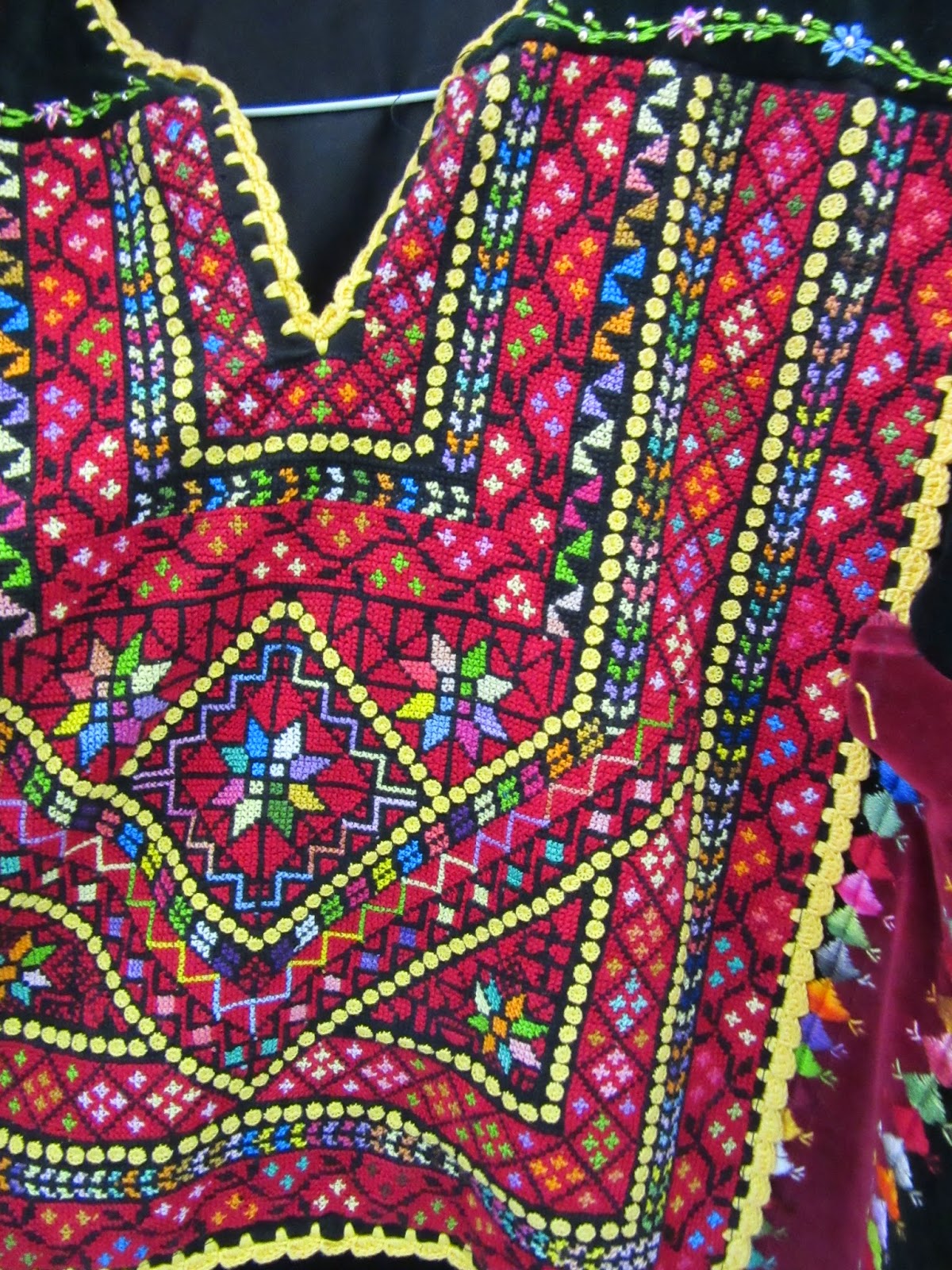

There were also some beautifully embroidered dresses for sale and it was lovely to go through them and see the handwork. It was time to go and we were now heading off to the Desert Embroidery project. This was very interesting as it is a not for profit organization which provides employment for women. The embroidery was and still is a very important part of the Bedouin culture, it was essentially used to decorate dresses, but the colours of the threads have special significance as to the age of the woman and her marital status. 

As the women are now more settled and not contributing as much, the project aims to help them by providing them with an income for their work and she earns regardless of sales. Apparently they employ 160 women on the project. It is also important to keep the tradition alive. I had a wonderful time looking a all the beautiful work, and bought some to take home as gifts, and had been the lucky recipient of some as well. It is also helping women by providing education classes for literacy, a mobile library, and a kindergarten.

I think this is a wonderful project and should be supported so I give the website here

www.desert-embroidery.org

We left here and then had to find our way to Be'ersheva. I never thought I would see camels wandering freely in the middle of a town, so Clara stopped and let me out of the car so I could photograph these. I was trying not to be too conspicuous, but people were staring at me.


Clara put Be'ersheva into the gps and off we went. We headed down this road towards the mosque and the gps was talking to us, so we were stopping our conversation to listen to it. We got to the junction at the end of the road which was opposite the mosque and went smola (left). We followed the road when all of a sudden it totally disappeared and we found ourselves driving across the desert............

Well.. we just carried on. There was no road, maybe just a tire track to follow, but the gps was telling us to carry on, it was not easy, the "road" was rutted and at times it was difficult to see the track. Our trusty gps kept telling us to keep to the right hand track, (yes, but where is it?), and at one point told us to take the right hand fork. That was a tricky one as there was a left, a sort of right and a definite right which headed straight into a Bedouin village of tents,  one of the official unofficial villages as they call them. We stopped and took the sort of right. Now, there are not too many cars in these villages, and you see lots of people walking, but on this occasion we were the only car out there. We must have driven across the desert for about fifteen minutes when all of a sudden, we can see the main highway. We had been laughing so hard that tears were running down as we couldn't believe that the gps would take us on this route, but I guess it knew it was there. We popped on to the road and it wasn't too long before we were in Be'ersheva. 

We met up with Nina and Ziva and had a lovely lunch and then went back to  Nina's home where she had laid out a wonderful array of her quilts to show me


Her work is lovely and based much more on the traditional, it was joy to see it. 


 I couldn't resist posting this again as they were so delicious....

It wasn't long until we were all in the same car and heading off to the Negev University in Be'ersheva as this is where Linda's exhibition was going to be, but prior to that we were going to hear a presentation that she was going to be giving. We found our way to the building and passed lots of university students, both Arab and Jew.  We opened the door to the lecture room, which announced our arrival by creaking as loudly as possible and there was Linda giving her lecture with slides in Hebrew. We found a couple of chairs at the back and Clara told me what was being discussed. When the lecture ended, there were lots of questions and someone asked Linda if she had shown her work outside Israel ( this was all in Hebrew, but Clara told me afterwards), to which Linda answered and mentioned my name and Canada. You have never seen so many heads swivel in my direction, I just waved.

When it was over, we all made our way into another building of the university where Linda's exhibition had been hung. Oh my.......... her work is amazing and  I have to confess that I took photos- but then so was everybody else. It was wonderful to just wander through and see her beautiful work, and I turned a corner........ and there was the camel quilt, "Blind Date". I couldn't quite believe it, and have to admit that I did stand there and cry, it was just lovely to see it again. 

Linda very kindly posed with it for me, but I think it's a little fuzzy sorry, and also very kindly signed the catalogues for this show, I told her how honoured we were to have had her work in Canada and thanked her again, on her part she told me how impressed she had been with the way we had handled her work, we left firm friends. I also me up with Yemima and Chaim again as they were there and also Eynia, it was lovely to see them.


I was then given a nighttime tour of Be'ersheva and then we had to head home.......

a brighter day........

We finished our day in Jerusalem by going to the Jerusalem Theatre to see a quilt exhibition, again we had had one of these beautiful pieces in the Ailsa Craig Festival, and again, it was good to see it.


Were up bright and early as we were heading into the desert today and going to Masada. Again, our drive took us to Jerusalem, over the hills and across the other side........ and then into a totally different landscape.

The sun was shining brightly and, in fact, there had been quite the discussion before we left between Yemima and Chaim as to whether we would actually be able to use this road as there had been some major flooding the day before with all the rain but they decided to take a chance. I am glad to say that all was well and we had no hold ups on our way.


The landscape is truly amazing and so different, and it wasn't long before we were passing Bedouin villages which was interesting to see.


We stopped a little further on at a sign that said Sea Level and there was a Bedouin man with his camel and a busload of tourists. I took a snap and Yemima told me he would probably charge me, but there were too many others who were happy to sit on his camel and have their picture taken, so he ignored me.


The route we were taking was going to take us along the edge of the Dead Sea, so this is why the sea level sign was there, we were now going to be dropping down 400 metres below it. The drive was lovely and we passed kibbutz and Date palms. It was also interesting to see a couple of companies that produce skin care and body care, my favourite being Ahava, which I have found for sale here in Canada, I did buy some body wash and lotion later in the day. We were heading for Qumran which is where the Dead Sea scrolls were found. The drive was long but interesting and we did stop a couple of times for photos.


Qumran is now in ruins, but it was a place where a very religious group had lived thousands of years ago, and it was thought that John the Baptist may have joined them for a while. 


This photo shows the sort of jars that the scrolls were packed in, and there was a display inside a small museum which had lots of information and even some small scroll fragments. The main area outside housed the buildings and ritual baths that they would have lived in and used. There were seven ritual baths and they would have had one to cleanse themselves before they ate. 

It was interesting to see in some small restaurants, a sink with a can chained to the tap with which you would see men wash there hands before they started their meal, especially the more religious.


The photo above, shows the cave where the scrolls were found. There was a shepherd boy looking for a lost goat, and he threw a stone inside and heard a clunk so investigated, he found the jars and took the scroll he found to a shoemaker as he thought he might be able to use them in shoes. Luckily the shoemaker thought there was more to it and showed a Rabbi the scroll and made the discovery. There have always been a lot of people who think the bible stories are just that, stories, but I believe the scrolls actually give credence to the existence of events. There are lots of caves dotted in the hillsides, makes you wonder what else they may find one day.

Anyway, it was time to move on as there was a lot to see at Masada. This is also my third border, I had seen Syria and Lebanon, and now I was at the Dead Sea looking across to Jordan. 

Before I left on this trip, several people suggested that I went into Jordan and to the Rose City of Petra, I would love to have done it, and there were tours I could have taken, but I was travelling alone and am not as adventurous as I once was, so decided I would leave that for another time when perhaps I might have a travelling companion.


Jordan across the sea


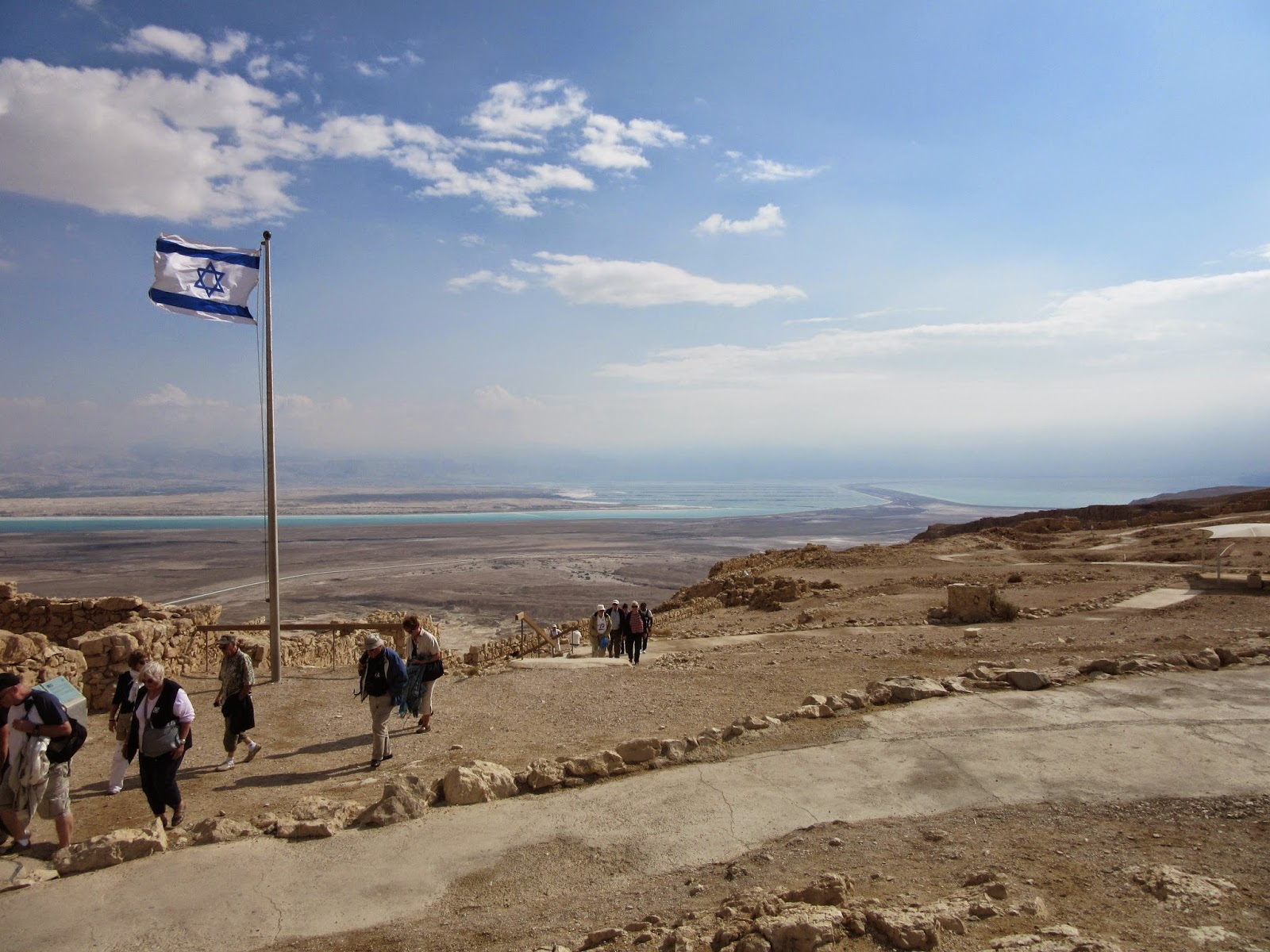
We carried on and it after a little while I got my first glimpse of Masada, a high plateau sitting alone and not joined to the rest of the mountains around it. It really is quite the place and I don't think my photos do it justice, so I shall do my best to describe it. We drove into the site from the east side, (I've just looked at the map), and from here we could take the cable car, or, if we felt really adventurous, we could walk up the Snake Path. They say it is nice to do that in the early morning so that you get to the top to see the sunrise, we were a little late for that, and it is quite the walk so we took the cable car to the top.


In this photo, you can clearly see the snaking path that would have taken us up. When we got to the top, the views are incredible. I had looked out of the windows of the cable car and got a little dizzy, I'm not great with heights, but I really did want to see Masada. I don't know how familiar you all are with the story of Masada, but it was here that King Herod built two palaces, the most impressive of which would be the northern palace. He also built a western palace.


I have to say that it was all very impressive and you had to wonder how they got all this stone up here in the first place, not the mention columns etc,. The photo above was one of the administrative buildings, and there was some beautifully decorated plasterwork in the corner. The black line in the wall is to show what they originally found upon excavation. Anything above that was added after they excavated the site to give an idea of what the building would have looked like. I found that very interesting and it did give a better sense of size and scale. The whole site was enormous.


This was a storeroom, one of several built side by side, but this one had been cleared so you could get a feel for the size, the others were still full of rubble 

Now, the story of Masada is very complex and I will try not to bore you too much, but I have cribbed a bit from the guidebook I got there as I would never remember it all myself! But the events of 74CE were written about by a Jewish historian, Joseph ben Mattathias who had links to Rome and was known as Josephus Flavius, it is all very complicated and it is probably best to research it for yourselves. But it would appear that Josephus wrote a book, "Wars of the Jews", which described events leading up to what happened on Masada, and he wrote it to discourage others from rebelling against Rome.

Masada is strategically very important, it is as I said on a plateau of it's own and the view over the area is also important, and a desert fortress would have been a necessity. To cut a long and complicated story short, Herod eventually dies and Masada passes to his son, totally incompetent by all accounts, and he was eventually deposed and a Roman garrison installed, Are you with me so far?
A full rebellion eventually erupted as the Romans were not sensitive to "Jewish religious sensibilities", I quote my guide book here. So the rebellion continues with emancipation from Rome being at the core. There was trouble in Jerusalem, and a small group then flees to Masada led by Eleazar ben Yair. So more fighting and eventually the Romans get to Masada.

The rebels are safely ensconced on Masada, and have food and water. The Romans are left to wonder how they are going to attack, and build a ramp on the western approach to Masada. They had built encampments at the base of Masada, and once the ramp was up, were able to fire into the rebel stronghold. However, the rebels have built a new wall and so the soldiers are told to burn it down, but the wind changed and the Romans were in danger of losing their own encampments.

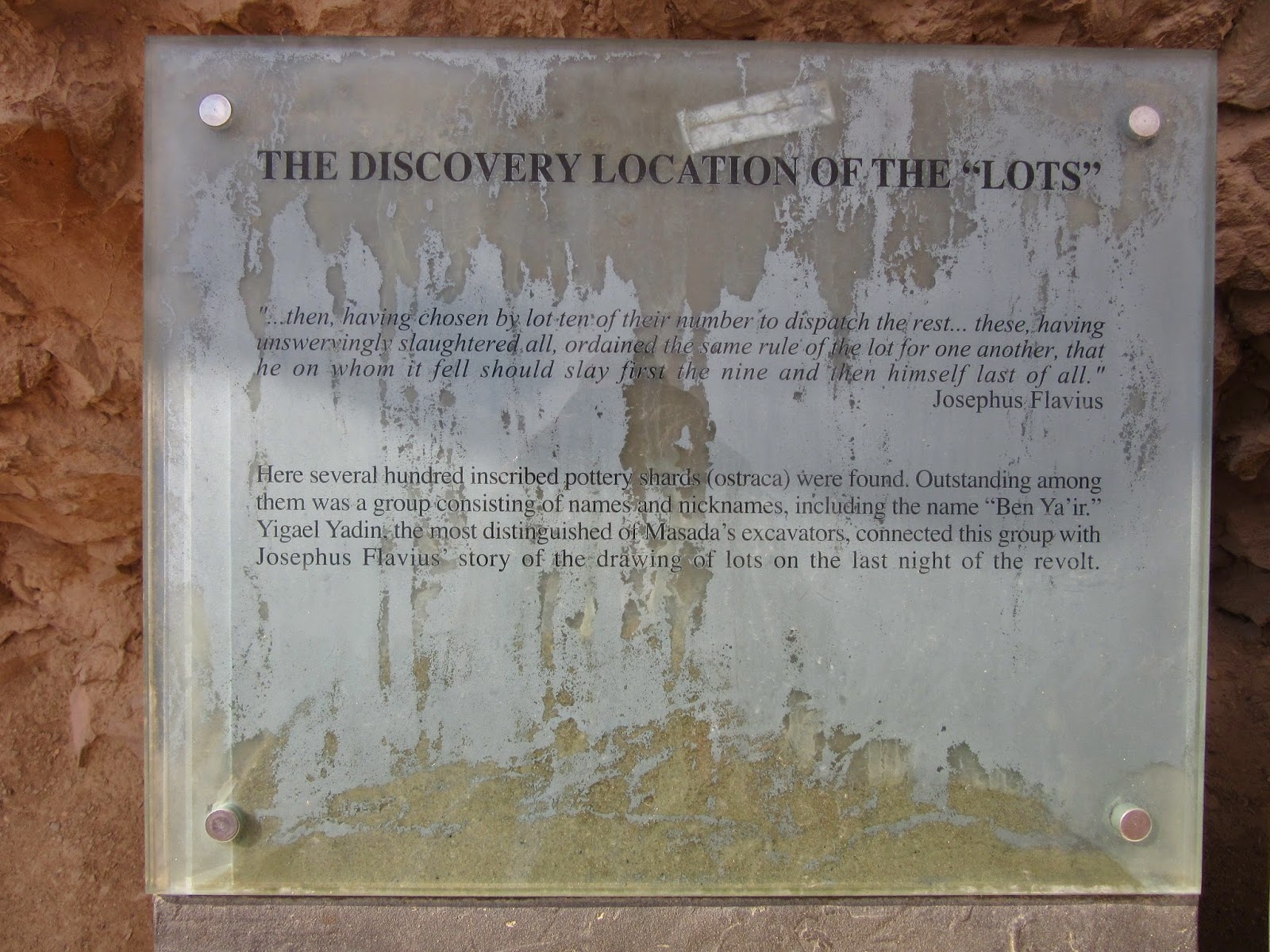
It was that night that Eleazar ben Yair called everyone together and made an impassioned plea to them. They would not under any circumstance acquiesce to Rome and become slaves, so that left only one option, they would all rather die. So, lots were drawn to see who would carry out this deed.

Ten men were chosen of which Eleazar ben Yair was one, and killed everyone on Masada and then themselves or each other. When the Romans finally breached the walls the following day, they were met by a scene which I am sure, they found unbelievable. There were only two women and five children who survived by hiding in water conduits, so they emerged and were able to tell the Romans what had happened.


The stones with names on which are presumed to be the lots that were drawn to see who was going to do the killings


Looking down on one of the levels of Herod's northern palace


This model shows what it would have looked like


One of the encampments which was on the western side.


The stairs down to the lower level of Herod's palace


Wall frescoes and columns


We sat and rested here for a little and ate some fruit and drank water. It was actually the perfect day to be doing this as it was breezy and although sunny, not too hot. In the summer I am sure it must be incredibly hot as there is no shade whatsoever.

We carried on and went into the ruin of the synagogue, there were several tour groups here with their guides, and we had a quick look when Yemima went into a room at the back of the synagogue and there, sitting behind a glass window was a scribe writing the Torah with a quill pen. I couldn't quite believe my eyes that I would ever see something like this. I watched him work in fascination as he copied the script from a master copy I suppose, and when he reached the end of a line, he would fold that line on the one he was following so he could copy the next line. Yemima told him I was from Canada, and he asked my name. He took a small piece of paper out of a jar and wrote my name in Hebrew, but changed the last letter, I will have to wait for clarification as to why as I can't remember but I will let you know when I get it. It was fascinating to watch and I don't know how he could chat and not make a mistake, I do know that if a mistake is made while writing the Torah it cannot be changed and the whole thing has to be destroyed. While I watched him work, I could here the tour groups outside, one guide even told her group, " oh there's only someone writing in there.." almost in a bored way and as if it was nothing really very special. It made me glad that I wasn't with a group as I think they miss so much.


My name in Hebrew. I have this very safe as I want it laminated so that I can use it, I will also scan it so that I can use it in my work. 


An explanation of the breaching point and the ramp on the western approach


One of the many Artisan's workshops


Again the mosaic floors were breathtaking, and I really enjoyed looking at them we spent a lot of time there and then took the cable car back down the mountain. Once at the bottom, we went into an excellent museum which explained in more detail what it was like to live there, and also had the lots which were drawn in a case.


The sun was beginning to go down now, so it was time to head home. I was moving on again tomorrow and had another great day ahead of me........