Thursday, December 11, 2014

onwards...........

.........and started to head towards the Western Wall, but first we had to have lunch.


(I've decided to do a separate piece on food so you'll just have to be patient.)

It was while we were having lunch that I started to go through my photos. I had taken so many pictures and wanted to do so because then I would remember every detail and nuance of my trip. I turned the camera on, got into playback mode..... and found that my camera had not taken as many pictures as I had clicked away at. I'm sure you can imagine my disappointment as I was going through in my head the pictures I was missing, and frankly, could have cried. I tried it a couple of times, and the egg timer spun around and then came up with "card error".

Luckily, I had my phone and I had made sure that I had deleted all photos from it before starting this trip. And so it was that it was pressed into service. (I contacted the husband by email later and told him what had happened, and the upshot of it was that I bought a new camera, a Canon Powershot SX600 HS, for those of you who are into cameras).

It was after lunch that Moshe and I walked towards the stairs that lead down to the Western Wall in Hebrew, Kotel. It is the one place that if you mention Jerusalem, is the first that springs to people's minds. There was lots of noise, as I said, there had been a group celebrating a Bar Mitzvah, so they had a couple of buses.


I should also describe the scene. We were standing at a set of steps leading down to the area of the Kotel. There is an entrance as you can see in the photo, and inside, army personnel and police with security scanners, (it is a fact of life that you will have your bag searched before entering any public building and there will be security guards at the mall as you drive in, you get used to it.) At the far end, we joined a short line as Moshe was hoping to take me up to Temple Mount. We stood in a short queue only to find out that they had just closed the entrance so no one was being allowed through. Oh well, never mind.

So Moshe took me just a little further down and we went into the Jerusalem Archaeological Park.  This really made you stop and think because I was standing in an area that Jesus would have been very familiar with at the base of the wall to the Temple, and in part of the original city that would have stood in it's shadow. We had seen a short film explaining how a pilgrim would have approached the temple and bought his sacrificial goat prior to going through the entrance to the temple, which was entertaining.

Now, the important thing to remember is this, to us in the 21st Century, we are used to seeing tall buildings in cities, it's what makes up most city skylines, and they are usually taller, bigger,  more modern than the last one that was built. Now close your eyes and step back 2000 years or more, and put yourself in a pilgrims shoes. You had probably walked to the City of David which was the original city, and the hills that surround Jerusalem would have been wooded, no buildings, you enter the Kidron valley below the city and look up........ 


It must have been a pretty impressive view, as the wall is huge, even to me it was big. So, this photo shows the wall which forms part of the Western wall, and the remains of Robinson's arch, named after an American explorer, this would have been one way of getting up to the temple, there used to be steps here. You have to remember that the Dome on the Rock now stands where the temple would have stood. The stones are massive, and there is no cement holding them together, they are not going to move anywhere!

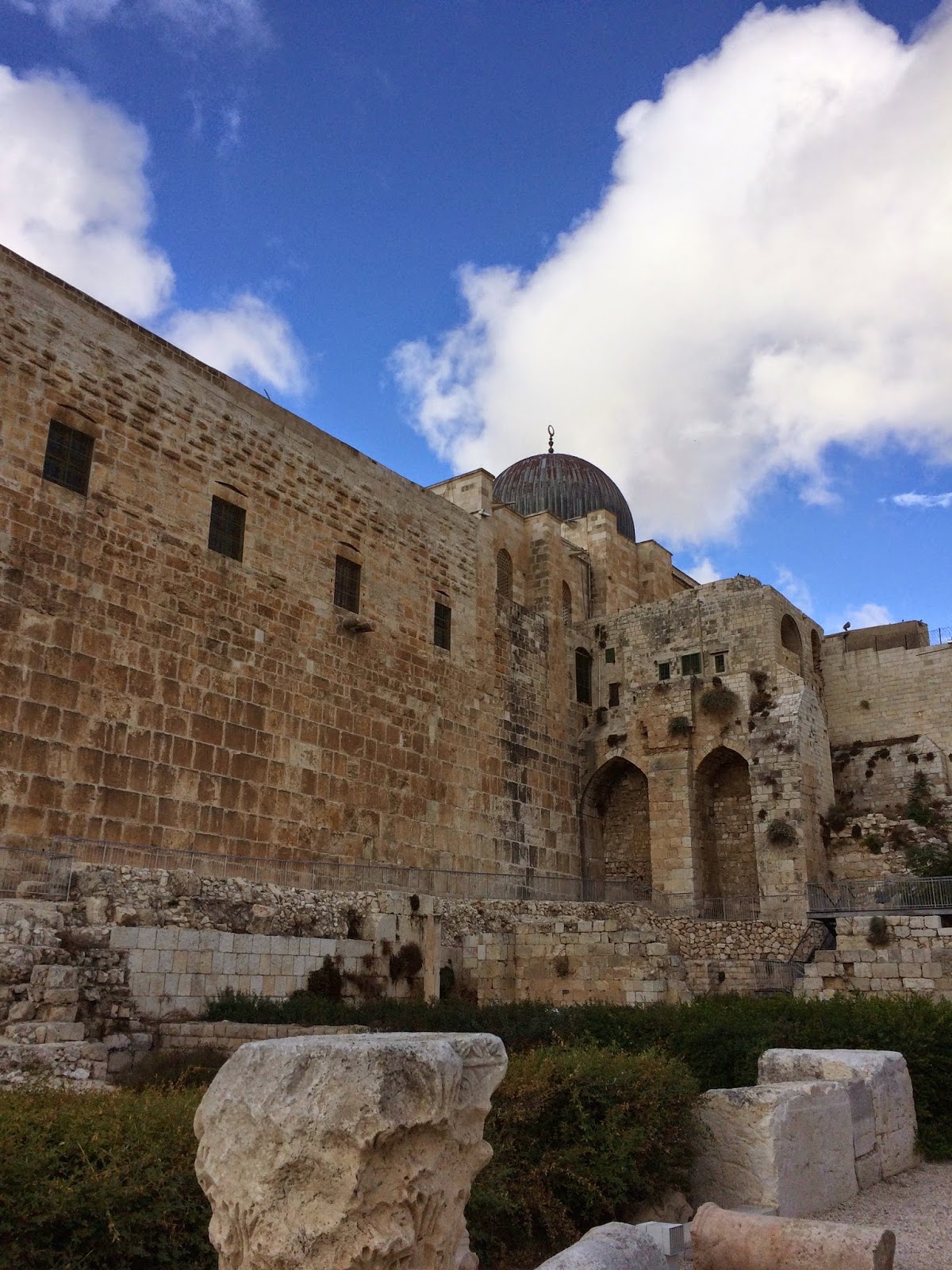


You can see the dome of the Al Aqsa mosque which is also on Temple Mount, and as we stood there looking up, the Muslim call for prayer went out across the city, and it was also echoed by another nearby mosque. The call really is very beautiful.

The Park was fascinating, and we found our way to the steps that would have led into the Temple area. It was interesting as the steps were staggered, Moshe told me that they wouldn't want you running up them as it would seem disrespectful, so you would be expected to approach it with a certain reverence, hence the staggered steps. He also showed me the original entrance at the top of the steps. There are actually two entrances, one on the right and one on the left, both now bricked up. This would have been the way in to the Temple area, it would have been through the right hand gateway and the exit was through the left hand gateway. However, if you went in through the left hand entrance, it meant that you had lost something, either a loved one, or maybe your sacrificial  goat ran away and you were looking for it. People would stop you and ask what you had lost, if it was a loved one they would give their condolences.


I think this shot looks towards the Mount of Olives. At this point, it started to rain again, so we moved back into the entrance area and waited for the rain to pass and Moshe translated the call to prayer that we could hear. He really is a fascinating guide and has studied other religions which, as a guide, gives you, the tourist, a better insight.

The rain subsided, so we decided to head back to the Kotel, so we went through the entrance. Interestingly, there is an entrance for women and one for men, I just followed Moshe.

Once through the screening, we found ourselves in the courtyard area of the Kotel. Again this is so different from the photos that you see in guide books and old photos of the Wall. There is a women's section to the wall as it would not be right for them to pray in the mens section. I had another mitzvah to do for someone, so Moshe told me to take my time and he would wait for me. 

I have to tell you that it was a very emotional experience. I approached the wall which was busy and waited until a spot became free, and then took my place. I can't tell you the emotions that flooded through me as I touched the stone in the wall that had stood there for thousands of years, it actually made me cry. 


I prayed, and left the note in a crack in the wall, said another prayer, took a deep breath and moved away.  It's no wonder that this is such an emotional spot for Jews and Christians alike. The photo shows the women section of the wall and the bridge structure would have taken us up to Temple Mount had we been allowed to go up.
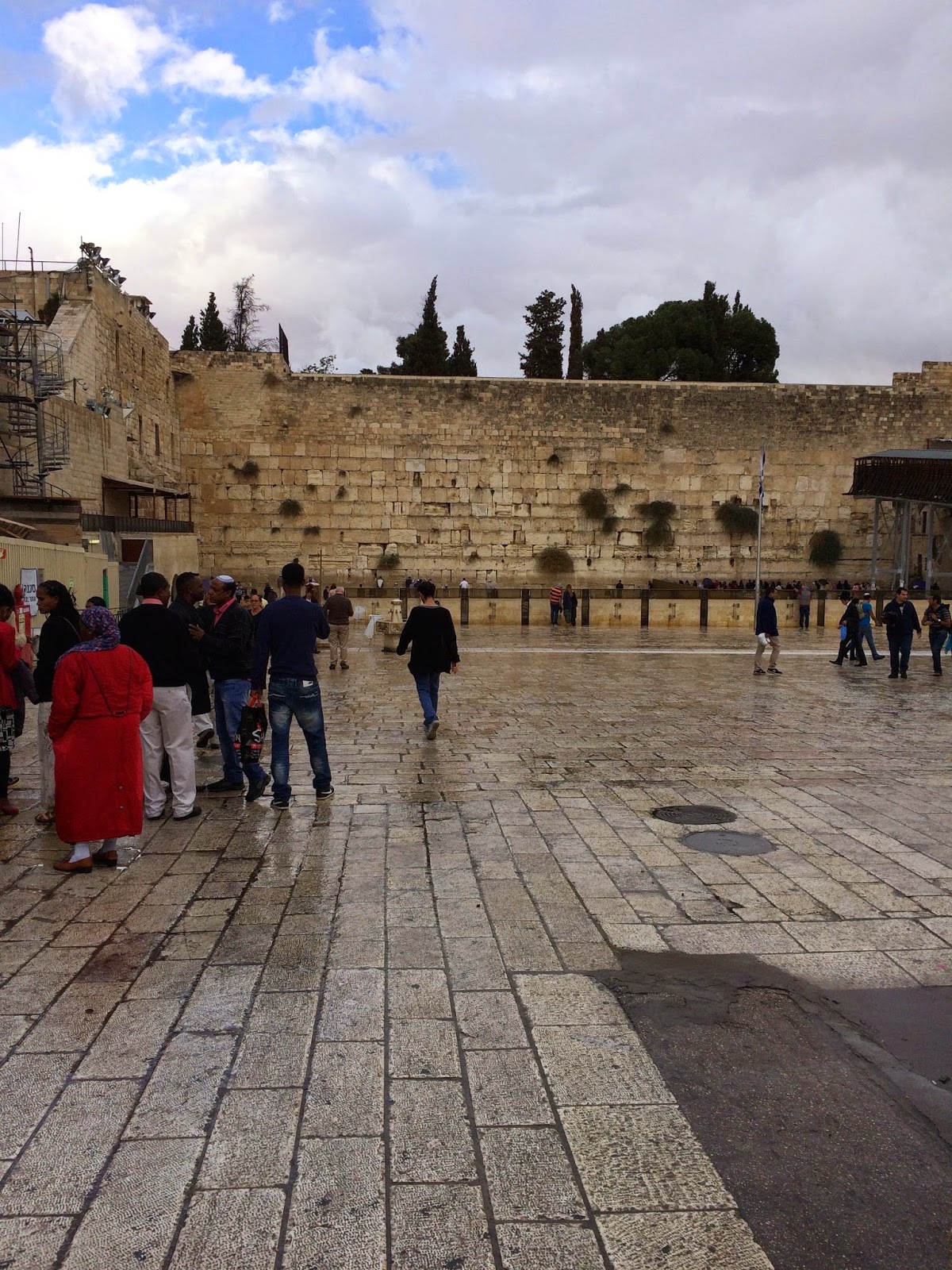

The mens section was almost empty, but it had been raining hard.

I found Moshe, and then we dived back into the market as he wanted to show me something really special, and believe me, it really was.


Remember that this is a living working city, and we were in a less touristy part than before. And suddenly, we dive into this alleyway, no tourists and no tourist shops, just normal businesses, a coffee shop, a butcher plucking and preparing chickens, I'm really off the beaten track here. 


We popped out the other end, and then I find myself walking towards a doorway that leads directly onto the Temple Mount. The doorway was open, and by it sat two policemen. 

  I thought we were heading through it, when just opposite them, Moshe dives into yet another alleyway. No shops just an alley that leads...... who knows where, but probably to homes. This is in the Arab Quarter of the old city...


All of a sudden, he stops and says, "this is what I wanted you to see". And there I am standing there looking at another section of the Western wall. If you took out all the buildings that have now grown around it, and you were standing at the Kotel where I had just been, this would have been further along. This was even more mouth dropping as I hadn't expected this, and it so far off the beaten track, I doubt that tourists even know it's there.


Again, it was incredibly moving. 

I am going to end this here, but I still haven't finished this day, but I think there is so much to take in that bite sized chunks is best.......... and I found this pretty emotional to write.


Wednesday, December 10, 2014

continuing..........

We went inside the church.

There were a lot of people inside, pilgrims from many different countries. Moshe was explaining the architecture and pointing out several interesting things, the fact that the last four stations of the Cross are situated inside the building, and then suggested we took the steep stairway up on our right to the top of Golgotha where Jesus was hung on the cross...( you are kidding....right? That's not where it was... really???).

Now, for those of us who can remember back to our RE lessons, we all have our images of where the cross was, and the hill, but it was OUTSIDE the city, this couldn't possibly be the right place, within the old city, inside a church. So, we climbed the steps and joined the queue that was going through the beautifully richly ornamented Greek Orthodox section where people were queueing up to touch the top of Golgotha which was situated underneath the altar.


To be honest, I found the whole thing utterly odd and just stood and observed, taking in the richness of the decoration and the watchful eye of the Greek Orthodox priest who was keeping an eye on everyone. We then went down the steep steps on the other side and saw through the glass panel the rock that formed part of the hill.

As we got to the bottom, we then turned to the left, and I found myself facing the Stone of Anointing which is where they laid Jesus once he was removed from the cross. It was an astonishing sight to witness. There were lots of Eastern European pilgrims, they had all come through the market to this point, passing many of the traders selling Christian artifacts. They arrived at the stone, opened their carrier bags, took out numerous crosses, small icons and other items, keyrings etc., laid them on the stone, knelt and kissed it, and then prayed silently. Then, they gathered everything back up, and put it all back in the carrier bag. 

As I say, it was astonishing to see it, and I was a bit taken aback really. We then moved further round the church and reached the tomb. ( I really don't understand this, it can't be here....). The queue for going into the tomb was incredibly long, so Moshe suggested we come back later in the afternoon when it quietens down a little. However, he did take some time to explain that the Church was built and then restored by the Crusaders in the 12th century. It has undergone many renovations since. 

Maybe I should add here what Moshe said to me as we went into the city, don't forget that this is a living, working city. It sometimes feels like a tourist attraction with Arab vendors selling Christian artifacts and hawking their wares trying to draw you into their small shops, but he is right, there was plenty to show that this is a place where people lived, had their homes and worked.


The city is also multi-layered with one period building on top of another in some instances. So this is why it can seem confusing. 

We left the church and walked a short distance and entered a Russian Orthodox church just a little further down the road, and saw what would have been the original entrance steps to the church of the Holy Sepulchre, again, I found this confusing, trying to get my bearings was proving a little difficult, but I had a good guide who was patient in trying to get me to understand what it would have looked like originally.

We carried on our way, down a few more alleys and up some stairs and suddenly, we were standing on the roof of the market, and looking at Jerusalem from a completely different viewpoint. It took my breath away, and to me I felt as if I was standing on the top of the world. From there we could see the domes of the church of the Holy Sepulchre, the minaret of the mosque the soldier jumped from, the dome of Temple Mount and the Al Aqsa mosque, all the domes were the same size, so no one dominated the other or was better than the other. 

It is noticeable that all the buildings in Jerusalem are the same colour, which ages gracefully and I learnt that, by law, all buildings in Jerusalem have to be built from Jerusalem stone, so there's an interesting fact for you.


From there, we went back down into the bustle of the market, and walked into the Jewish Quarter and it was here that I saw the Cardo which was originally the main street which ran north to south as opposed to the Decamanus which runs east to west. It was interesting to see how this would have looked in the time of Jesus and he would have been familiar with it probably.


The street would have been quite wide and there would have been stores lining it even at that time.


As we turned into the Cardo, Moshe pointed out this stone in which squares had been scratched into it, and told me that it had probably been done by two bored Roman soldiers who were playing what I think, is known as Kings game, but whatever they had a game to pass the time.


All the columns bear a mark which could be the stonemason's signature, but also each and every one was marked so that when they came to put them together, they knew which column went with which base and ornamental top. It's not something I'd ever given much thought to, when you see a column, you just assume that its all in one. I also marvelled at the fact that they would have made these beautiful round columns with the most primitive of tools, and yet they were smooth and round.

From here, we went on to the Yeshiva, ( a seminary), which stands on Hurva Square and down into the depths to view the house of a wealthy person from the time of Jesus, it could have been the house of a high priest, I don't think anyone really knows. It would have been very richly decorated, and there was evidence of redecoration. There was a beautiful mosaic floor on which another one  had been laid on top, a bit like us changing the carpet, or putting down hardwood.

All of a sudden, there was a commotion in the street and lots of singing and music, a Bar Mitzvah was taking place,and the crowd was making its way to the Kotel, (Western Wall) so after a little more looking at the ruins and artifacts, we exited the building...............


Tuesday, December 9, 2014

.....Jerusalem...........

I have been thinking about what to write.


Jerusalem..........
Its very name conjures up so many images in my head, that it is difficult to know where to start. So.... I will take a deep breath and start at the beginning, but this post may well stretch over another two or three as I saw so much.

 Lets see how we go.

I had been told the night before that we would be leaving for Jerusalem on the 6.40 am bus. Moshe doesn't drive, so this was how we travelled, and it was easier as parking can be difficult. Shoshi walked me two blocks, where Moshe was waiting for us, and then we walked to the bus stop, where the bus came bang on time. It was going directly to Jerusalem making a few stops before hitting the main highway, but it was a little over an hour when we disembarked at the central bus station in Jerusalem. It was also better to arrive in the city earlier as it does get very busy even in November. It was also a wet day, it had rained overnight, and there was the threat of more rain during the day

What can I tell you? What was my first impression? I actually did four separate trips to Jerusalem, each time seeing completely different things, and each time I got a different impression.

Where Tel Aviv was a modern city, with a lively restaurant and night culture, although I didn't see that side of the city, Jerusalem was so different. The bus started to climb towards the city, and on it's outskirts, I was struck by the fact that the hills are of white stone which with the green of the trees, was a contrast. Also, as you get closer to the city, there are bus stops and at that time of the morning, there were children waiting to catch the bus for school, and they looked different, the girls were dressed in mid calf length navy skirts with blue shirts, the boys were dressed in black with their ringlets  and wearing the yarmulke and/or black fedora.

(I've just read that back, who am I to say they are different? Might they not be thinking that I look different? I certainly did not dress as they did, and if anything I was the odd one out).

It was also extremely busy, the traffic slowed and it was a slow journey to the bus station, but its like that every day. Once we got to the bus station, we then took the light railway to the outskirts of the old city. Again, it was busy with people rushing everywhere and lots of standing room only. We got off near the city hall, which is a short walk from  the old city.


We walked a little further and waited to cross the road and Moshe told me about the building on my left which had been a hospital. The road also formed the border at one point between the Arab controlled city and Israel. The story goes that one of the patients leaned out of the window, and promptly lost their false teeth. So it was that a delegation from the Arab side, the Israeli side and a UN delegation were rounded up to enter this area and retrieve them. 

We entered the city by the Jaffa Gate, one of the main entrances to the city, and we did it as they would, walking through the entrance rather than the road as many tourists were doing.

It was quite exciting. Once through the gate, we started walking to the entrance of the market and passed a couple of Ottoman tombs, it was unknown whose they were, rumour had it they might have belonged to the architects of the city...............


So, a short walk and we were just about to start entering the Muristan...


It was like stepping back in time. We started walking down this alley for a short distance, and then took a right hand turn, and then another to the left and a short while later, Moshe stopped and asked if I would like to go into the store we were standing in front of? Would I? Who wouldn't, it was a fabric store. He knows the owner, who was Arabic, so he told him that he had brought me to visit the city and he was very interesting to talk to. He had the most wonderful selection of fabrics from Damascus, Syria, Morocco and India plus many others, they included the most beautiful silks from these countries, and he pulled out many things for me to look at, table runners, cushion covers and the most beautiful silk shawls and scarves every time I said "ooh" something even more beautiful would come out. He also knew his fabrics and told me that he knew better than the Jews what fabrics they should have for which holiday, beautiful silks for Yom Kippur, there was quite the selection, but... with the unrest in that area at the moment, there is no more being produced, the factories are closed, so what he had was probably all there is. I liked his honesty and chose a couple of gorgeous silk/polyester shawls, which were woven in Syria and he suggested I had the table runner he had shown me, ( how did that happen?), if I didn't want to use it, I could cut it up and make cushions...... well, he gave me a discount so I was happy. It is expected for visitors to bargain, I let everyone else do it for me as I generally forgot and was quite happy to pay what was asked, it must be the Canadian way, we are so polite.

With the shopping done, we carried on our way, and eventually came to the Church of the Holy Sepulchre.


This is a difficult place to make any sense of. The church is shared by six Christian denominations, not necessarily equally, all of whom watch each other like hawks. It is one of the bizarrest places I have ever visited. Moshe and I were standing in the courtyard prior to going in, and I have to say that my initial thought was, "is this it?" Almost a huge disappointment, I'm not really sure what I was expecting, was I expecting a host of angels singing a heavenly chorus to appear, or was I expecting something more humble or grand? To be honest, I found Jerusalem as a whole a lot to take in and understand. You will notice in the photo a ladder outside the window on the upper storey. This ladder,( which may have been replaced over the years), has stood in this spot since the mid 19th Century. I asked Moshe for the story as my memory is a little vague, and he told me that it had originally belonged to the Armenian community and they would take food into the church through the window as they were locked in there for long periods. The Status Quo Agreement was signed in 1852 and the ladder remains there to this day.

And we haven't even entered the church yet................

There is also another story which relates to the outside entrance that can be seen in the photo. There was a conflict between the Armenian Community and the Greek Orthodox community, the Orthodox were not allowed to enter the church on Easter Saturday and could not get to the Holy Fire which descends into the chapel of the tomb. They stood at the entrance to the church, and a miracle happened, the fire descended, and set fire to a pillar the entrance. A turkish soldier standing on the minaret of the mosque opposite, saw this, and he became a Christian believer, and jumped from the tower to join those at the front of the church. The stone softened and to this day, his footprints are embedded in the stone........


And there, dear reader I will leave you to ponder this and gather my thoughts for the next instalment.....


Saturday, December 6, 2014

Old Jaffa and Tel Aviv............

I was up bright and early the following morning as this day was going to be spent delving into the history of Jaffa (Yafo) and Tel Aviv.

It was a beautiful day, and shone brightly with a lovely warm sun and wind if I remember. Shoshi dropped us off early and we made our way into the centre of Jaffa, starting at the square and then making our way to the Egyptian archway


This is actually a replica of the original. A lot of Old Jaffa was bulldozed by the British as they were trying to destroy the maze and warren of alleyways in Jaffa, if there were attacks against them, it wasn't always easy to find the perpetrators. As Moshe said, if you had no reason to be there, you didn't really need to have the streets named, this was borne out later in the week. I am glad to say that there are still some alleyways and streets that beg to be explored........


(I would add at this point, that if you feel I have something wrong, please do not hesitate to let me know and I will correct it, with every best intention, I tried to write many detailed notes, but it didn't always come out that way and Moshe told me so much that I am delving into my memory banks to remember it all and sometimes it doesn't make sense to me!!)

I had fun wandering through the winding streets and alleyways, it was a real experience. I showed some friends my photos recently and they were surprised/disappointed that there were so few people in my pictures, why was it so quiet? It was partly deliberate on my part, as I am thinking art so I tried hard not to get people in my pictures, I can tell you that there was no shortage of tour groups going around, sometimes we had places to ourselves, other times, we collided with more than one group, so trust me, there were lots of people in Israel!!

Moshe took me to St Peter's Cathedral, the start of our tour, and remember that this is Sunday, and we went into the cathedral it was lovely and the Kedumim square it was situated on was also very lovely. Just across from it was the museum with some of the excavated ruins from the Roman period, which was very interesting, looking down on what has been covered by later centuries, I think one would not have far to dig in Israel anywhere to find archaeology.

The museum had a very interesting history of Jaffa in English which was quite fun and told in a way to be entertaining explaining about the port and what would have landed there, and also the story of Andromeda's rock. This is where Perseus swept down on his horse, Pegasus, and killed the monster which was about to eat Andromeda who was tied to the rock to appease Poseidon. He marries her of course........ It also talked about Napoleon and his armies who never got here if I am correct, I know I could have sent him a postcard later in my trip saying "wish you were here......." because he never made it.

I looked up info on various websites about this, and thought that some of the reviews were sorely lacking, you really do need a good guide rather than just wandering on your own.


This is the view of Tel Aviv from Jaffa, we had walked down to the sea from the hills above to see this view, it was really beautiful. Having walked through the old town, we suddenly burst out into the hustle and bustle of Jaffa, still an old town, but full of life. Moshe wanted me to try almond milk, and I have to tell you that what we buy in the grocery store doesn't even come close to it..... It was delicious, cold, sweet and very refreshing, there were lots of interesting stores to explore, but that'll have to wait, and there was the wonderful clock tower that had been built in the Ottoman period,it was completed in 1906, but looked terribly European.


It was after this that we took a cab into Tel Aviv and got out on the tree lined Rothschild Boulevard. It was a lovely wide road with a tree lined centre with a walkway and very pleasant, the traffic roared about us either side, ( I haven't forgotten that I will talk about that). Moshe said we were heading for one particular place and he hoped it was open....... 

Luckily it was. We crossed the road and approached this rather odd looking building, squat and square, with very small windows almost across the top of the building and further down.


This had apparently been the home of the Mayor of Tel Aviv, Meir Dizengoff, who left it to the city for a museum.and art gallery. His choice of art was derided, as he was buying mainly copies, but, as an artist myself, isn't that what we do, copy things? He used to ride his horse to his office just a little further up the boulevard, and was once given a ticket for "parking" his horse outside the building, and there is a statue of him on his horse outside here.

It is now known as Independence Hall as this is where David Ben-Gurion gave his speech the day they created the State of Israel. He sent a messenger out to all the Minister's homes, asking them to keep this secret, but there would be a meeting at 3.30pm at this building. Well, you can imagine how that went. It was a very interesting place, our guide there was a young man who did his best to explain, but I got a detailed description. They also played a short excerpt from his speech.It was interesting as the day after this speech creating the State of Israel, the armies of neighbouring countries converged on Israel. I state this as a fact, no other reason, but it also tied in with the film I saw before coming over, remember the documentary on the Israeli airforce?

After we left here, Moshe told me a bit of the history of the area. I was standing in what was originally the beginnings of Tel Aviv. It was nothing but sand outside the city of Jaffa, and Rothschild bought up great tracts of land in Israel, and so here, they held a raffle for building plots and then houses were built. They were very beautiful and there are still one or two there. The original city was based here, and was composed of two streets, at the end of one sat the school but that has since gone and now the Shalom Tower sits in its place. There are some very beautiful mosaics inside depicting scenes from Old Jaffa, a more modern one with interesting scenes and on the second floor, architectural models of some of the original houses which would have been beautiful. There was also a  large model of the city of Tel Aviv which was interesting.


We then left here and took a cab to Sarona. This was a former colony founded by the German Templars in 1871 for agriculture. The story was interesting, and the buildings had a distinct German feel to them. They have all been beautifully restored and now house boutiques, restaurants and specialist stores and the information centre.


 A short while ago, they wanted to widen the road at this point, so instead of pulling the buildings down, they dug underneath them, and put them on rollers, and moved them back about 12 feet. I was glad they had come up with such an innovative idea. To get here we had driven through some very interesting buildings which were designed by the Bauhaus. The Bauhaus was a German design group in which they all lived and worked together to design houses, furniture, ceramics and other items from what was known in Europe as the Art Deco period. Some of the designers fled to Israel at the start of the second world war and worked there. It was so interesting to see the Bauhaus style in all its glory. It was here that it struck me that most housing is apartment living. Land is very expensive, and there isn't that much of it, so they build up. Shoshi was telling me that if the owner of an apartment building wanted to they could, with permission, put another couple of stories on top of the existing building but they also had to build a shelter in as well.
Lunch in Sarona was lovely.

We had visited the olive press and had an interesting presentation on the growth of Sarona, but it was time to leave. So we hailed a cab and had a very entertaining ride to the last stop of the day which was the Reading Power station. Our taxi driver was great fun, and cam out with all sorts of interesting facts on which he quizzed Moshe.( If Cathy had been with us, she would have had the name of his firstborn, the names of the grandchildren,where they all lived, how long he had been married............ it's what she does on taxi rides, in fact, when we were in Birmingham last August, I thought the CEO of the QGBI was never going to stop laughing on our taxi ride one evening after Cathy had asked a question of our taxi driver). I at least answered a question correctly which I was rather pleased about. ( There was a diplomatic car ahead of us, how could he tell which country it belonged to? If you want to know, it was to do with the first two numbers).

We got out under the shadow of the power station at Reading, and it was there I found myself at the mouth of the Yarkon River which flows out into the Mediterranean. 


We looked at the memorial to the crossing of the Yarkon River by the British during WWI. The sun was beginning to go down at this point, but it was a very beautiful spot.


We watched small aircraft coming into the local airport there and then strolled into the Tel Aviv port area. This had been revived and now housed restaurants, cafes and shops. It was a very lively bustling area and we sat for a little enjoying ice cream, the best I ever had, and it was nice to just sit for a while watching people stroll by and enjoy the end of the day.......


Thursday, December 4, 2014

......

It was dark when we arrived at Shoshi's apartment and also the end of the Sabbath. We were going to pick up her mother and her brother, Moshe, who was going to be my guide for the next part of my journey, as we were going out for supper.

Off we went, and while we were eating, Moshe asked me what I wanted to see, what was I interested in? Where do you start to answer a question like that? I knew we were going to Jerusalem, so what should I be thinking of seeing there? Well, history, archaeology, and whatever else would be appropriate, I do love history and I thought it important to learn, and the only way I would do that would be to delve into the history, biblical and otherwise of 2000 years. I hoped that gave him some insight, and I was happy to leave it up to him.

I should explain that Moshe is a tour guide, and my goodness, I couldn't have a better guide. He was a scholar, and what he didn't know about a place and it's history in Israel probably isn't worth knowing, and if he didn't know it, he would have found out about it and let me know. We had a very pleasant evening in the restaurant, and then he said to Shoshi that he would like to show me a couple of places this evening before going home. And so it was after the meal we headed for the town of Holon. It's right next to Bat-Yam, and they spill one into another, and after a bit of direction, Shoshi let us out and we left her to park the car. I shall talk about traffic in Israel - it's very interesting, but that will have to wait for the moment.

We had stopped at a park which Moshe wanted me to see as there were all sorts of children's stories depicted. It was really lovely and some of the stories were fun.

I loved these little elves in their upturned mushroom

This story was possibly my favourite. It involved the story of hair lice, one of which was searching for the perfect spot which she found on the top of a head without any hair, and there was a model of a bald head with a lice/louse in a deckchair sunning herself under an umbrella. The head rather reminded me of our neighbour who happens to be bald so it rather made me chuckle thinking about it. It apparently cause a bit of a problem with the children if they happened to have lice and needed treatment as they were all worried they might be killing the little lice/louse on top of the bald head. 


This story, which was built on a hill which one walked up, was about ego and was a lovely tale. The last photo shows Mrs Pigeon who moves into the building and is very happy with her lot.

It was a lovely park and there were lots of other pieces to look at and stories to learn. But, it was time to move on, so it was back to the car and with Moshe directing, we then drove around a little before ending up in what I thought, was a very interesting area tucked away from any tourist area.

We are all familiar with the parable in the Bible of the Good Samaritan, but what I didn't realize is that the Samaritan's really exist and there is a small community of them to this day that live in Holon, and this is where Moshe had brought us. I was fascinated.

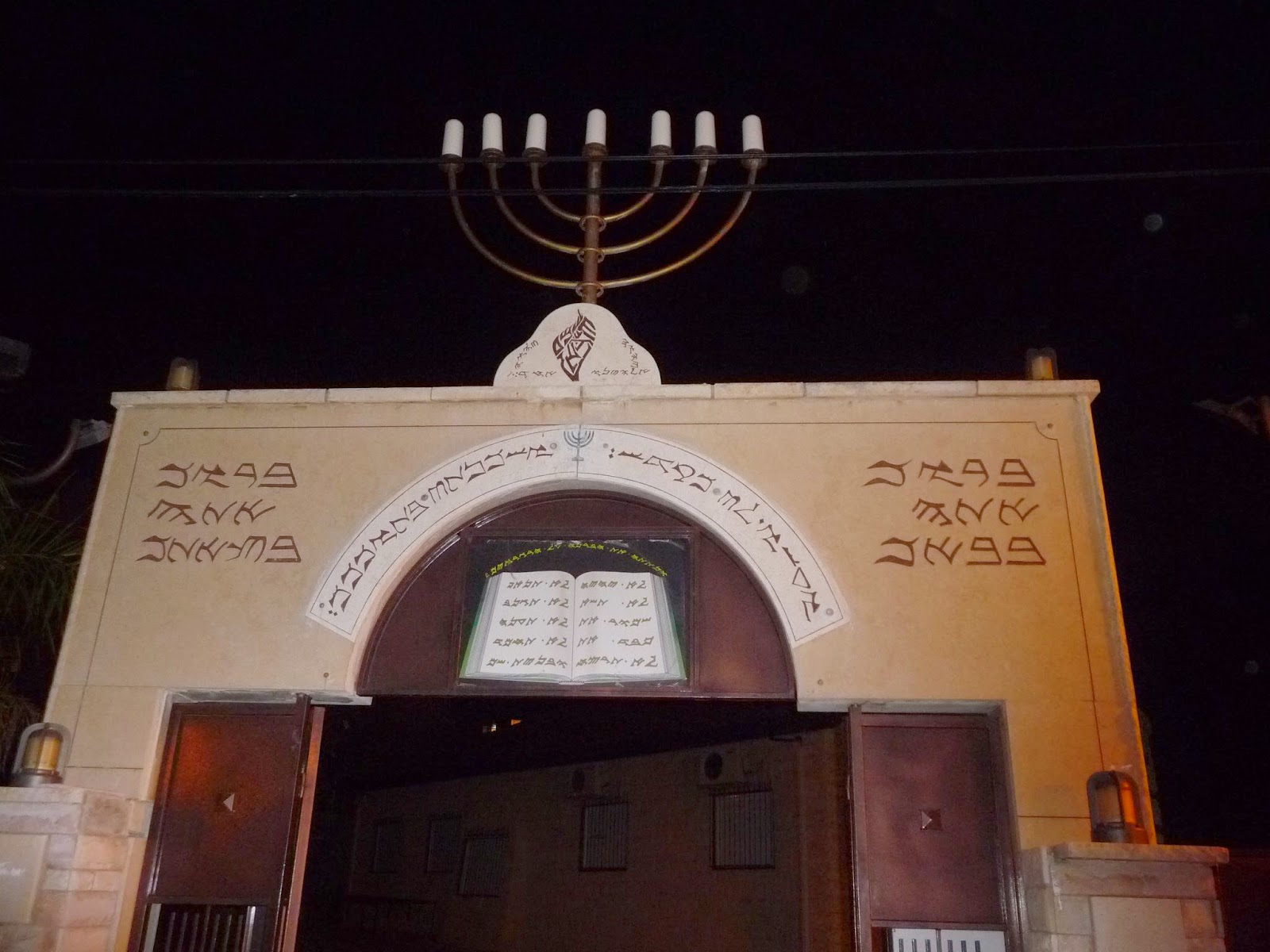
The area was not huge a few dozen houses, but there was the synagogue at the end of the street. The text above the door is ancient Hebrew which is still used by the Samaritan's and is totally unlike the more gothic or modern day Hebrew text which is similar to Aramaic, this was very angular. The synagogues are also very different to the ones that we think of today, apparently there will be carpets on the floor of the synagogue, no pews,  and the congregation will remove its shoes before entering. Now, if you think that is similar to a mosque you would not be wrong but thats what they do.

In a Jewish home, there will always be a mezuzah on the door post, this contains a small piece of the Torah and is generally touched on the way in through the door. I have seen many and actually saw the children in the Hebrew school touch it as they reentered the classroom after a break.  The Samaritans have theirs over a door way which I found interesting.


Even the street signs are in three languages, Hebrew, English and Samaritan. Moshe also told us about the festival of Sukkot which is different again in this community.  Sukkoth takes place five days after the solemn time of Yom Kippur, and is a joyous celebration. It involves building a sukkah outside, which has three sides that will withstand wind, and the roof will be covered in palm leaves and other ground grown plants, ( I have looked this up as I know a little but not much and I want to get this right.) It will then be decorated. In the Samaritan community, it is inside the living room and will have fruits hung from it, Moshe tells me that he had been inside and seen one at the Festival of Sukkoth. 

This was the start of my education and things just got better from here on in. I will not go any further than to say that after this we dropped them off and went home, and I was going to be spending the day with Moshe doing Old Jaffa and Tel Aviv, and if you think that doesn't sound like very much, wait till I tell you about it.........


Wednesday, December 3, 2014

........on........

There had been quite the storm during the night, but I was awake bright and early.  Eti and I made a quick trip to a local store to get Challah for the Sabbath. It was extremely busy and I found out that shops offices and public transport will all finish around 2pm on a Friday afternoon in preparation for the Sabbath. Quite a lot of people will also have the Friday off as well, except schoolchildren who will only have that Sabbath off and be back at school on Sunday. Maybe that is something that should be employed everywhere....

I actually enjoyed the Sabbath, it was a lovely day as it was a real family day and the Shabbat dinner the night before is also a time for families to get together and eat together, but it was nice to see people in Museums, enjoying a stroll on the promenade and eating in restaurants together. But I'm jumping ahead a day telling you this....

We got back, unpacked the shopping and then it was time to go off on my really exciting visit!! (Oh, do get on with it..........).

When Shoshi had met me at the airport the previous morning, they told me that Eti had been able to arrange a visit with Linda Bar-On..... the smile on my face was as wide as the Mediterranean. If you were at the Festival last year or at one of the trunk shows, then you will be familiar with Linda's work as we had eight pieces in the show. Exquisite work all hand done and each had a story to tell.


This one was a particular favourite of mine, "Blind Date", and was a wonderful piece, the camels had so much individuality. Linda is a very private person, so I think I should respect that and just show the quilts that we had. 

 It was a wet drive over to Linda's village and then the sun came out. As we parked outside her house the heavens opened and we waited a minute or two, but it just got heavier so we ran for the door to find Linda waiting with umbrellas as she was on her way out to meet us. She gave us a lovely warm welcome and invited us into her home. Her husband Gideon was also there, and while Linda was busy in the kitchen making tea, he and I chatted.

It turns out that we used to live not to far away from each other in the UK. We were in Croydon, and they used to live in East Grinstead, and later in Brighton. I taught in Lingfield at adult Education, so knew East Grinstead well, and also used to go car booting in Brighton as they did! Linda's home was very colourful, with white walls blue paintwork, and a wonderful collection of textiles from other countries and she was gracious in giving me a tour so that I could see it all. There were decorated hangings which would have covered a camel saddle for a bride to ride on to her wedding, amazing work, patchwork squares on end and bordered by panels of embroidery, it had a  locket of a child's hair attached as symbol of fertility, a fibre snake which features heavily in some folklore. Most of the pieces came from Uzbekistan, Turkmenistan and other countries in that area and also the Middle East that Linda had collected over the years, many looked to be antique. They were colourful and beautifully executed pieces of work which were even more breathtaking when you thought that they were done with the minimum of sewing aids, all by hand and with whatever fabrics or weaving were at hand. Every room revealed a new and exciting piece, beading, Kantha embroidery, fringing and tassels.


It is always wonderful to meet an artist in any medium, paint, graphite or textile, as it is only then that you get the full story. Having had this wonderful tour, I could then see and hear from Linda herself, where the influences for her own work came from. I have to admit to being slightly in awe of her as she works in a way I wish I could, but if I did, it wouldn't be mine. However, I have an idea buzzing around in my head, which is influenced by her work and I hope to start on it later today, or at least that's my plan. Her library of books was wonderful, more books on textiles rather than quilting, and on all forms of textiles, weaving, ikat, and many others.

I wish I could convey all that we talked about and all she told me, but it wouldn't mean as much. She was extremely generous with her time, and showing me around her home and it was a real thrill when she said that she had brought in three new quilts from the studio to show me....as they say, OMG!! I was thrilled to bits as I got to hear the stories from the artist herself and to talk to her about her techniques, (if you want to know, she does all her sewing and embroidery standing up, her table in her studio is waist high so doesn't necessitate bending), and looking at the fabrics she uses and the precise work, all embroidery stitches are the same in length or look as if they are and are not marked out beforehand.  They were stunning works. She also told us that she was having an exhibition in Be'ersheva which would be opening on the 18th November. Oh, bliss, oh joy!! That was just before I would be coming home, so Eti and I made sure that Shoshi knew that so my itinerary could be adjusted accordingly, ( I will tell about it, but I am doing this as a day by day, blow by blow account so please don't fall asleep). I also met Linda and Gideon's cat, Sadie. Gideon expressed surprise that she came and sat on a chair in the house as she usually keeps away if there are strangers around, but I didn't tell them that I have this affinity with cats and can usually draw one near that doesn't normally like people.

I couldn't thank Eti enough for arranging that visit, and I have such wonderful memories of visiting someone I consider to be my heroine.

Saturday dawned bright and sunny with no further rain, and Eti and Ruth, whom I had met on Thursday were taking me off to the Tel Aviv Museum of Art. I love museums and art galleries, and can spend hours roaming. I took the little ones from next door to Museum London just before I came away, they are getting too big for children museums etc., so I thought I should start introducing them to Art. We had a lovely time, a nice lunch and I thought maybe an hour would be long enough for them. I had to pry them away from exhibits and interactive computer displays. My only complaint would be that there are programmes for schools in the city, but we are rural and don't seem to be included in this, or at least that's the way I saw it as I've never heard of them going to  London with the school. I don't think it should be assumed that rural kids don't need that exposure, it's very important, I think the children should be comfortable going into any museum or gallery so that is my life mission, to accustom them to it and let them be comfortable. Problem is, Toronto's a long way away...................

Anyway, there I am off on a tangent again.

The Tel Aviv Museum of Art was a wonderful place. There were some amazing permanent sculptures outside on the concourse, and I spent a lot of time looking at them. On the inside, there was the biggest Roy Lichtenstein painting I have ever seen, the husband is a big fan of his, and I was sorry I couldn't take photos of it. There were some interesting exhibitions, the art of David Reeb, political, left wing and very dark themes but interesting, a gallery of Israeli art from 1900-1940, a personal favourite and I would have loved to have spent longer looking at it, video art, but forgive me I have never understood video art and this one was no different, it was about a woman with a bed searching for a home, or that's what I think it was supposed to be about, but it seemed to consist of her hanging from a wall or lying on a bed, so I think it is not meant for me to understand.


Some of the wonderful art on the concourse

I was being collected by Shoshi this afternoon as I was on the next stage of my journey, so we went home had a lovely lunch and then a brief rest.  Shoshi arrived later and we had a quick coffee and then it was off to Bat-Yam...........