


Were up bright and early as we were heading into the desert today and going to Masada. Again, our drive took us to Jerusalem, over the hills and across the other side........ and then into a totally different landscape.
The sun was shining brightly and, in fact, there had been quite the discussion before we left between Yemima and Chaim as to whether we would actually be able to use this road as there had been some major flooding the day before with all the rain but they decided to take a chance. I am glad to say that all was well and we had no hold ups on our way.

The landscape is truly amazing and so different, and it wasn't long before we were passing Bedouin villages which was interesting to see.


We stopped a little further on at a sign that said Sea Level and there was a Bedouin man with his camel and a busload of tourists. I took a snap and Yemima told me he would probably charge me, but there were too many others who were happy to sit on his camel and have their picture taken, so he ignored me.


The route we were taking was going to take us along the edge of the Dead Sea, so this is why the sea level sign was there, we were now going to be dropping down 400 metres below it. The drive was lovely and we passed kibbutz and Date palms. It was also interesting to see a couple of companies that produce skin care and body care, my favourite being Ahava, which I have found for sale here in Canada, I did buy some body wash and lotion later in the day. We were heading for Qumran which is where the Dead Sea scrolls were found. The drive was long but interesting and we did stop a couple of times for photos.

Qumran is now in ruins, but it was a place where a very religious group had lived thousands of years ago, and it was thought that John the Baptist may have joined them for a while.

This photo shows the sort of jars that the scrolls were packed in, and there was a display inside a small museum which had lots of information and even some small scroll fragments. The main area outside housed the buildings and ritual baths that they would have lived in and used. There were seven ritual baths and they would have had one to cleanse themselves before they ate.
It was interesting to see in some small restaurants, a sink with a can chained to the tap with which you would see men wash there hands before they started their meal, especially the more religious.


The photo above, shows the cave where the scrolls were found. There was a shepherd boy looking for a lost goat, and he threw a stone inside and heard a clunk so investigated, he found the jars and took the scroll he found to a shoemaker as he thought he might be able to use them in shoes. Luckily the shoemaker thought there was more to it and showed a Rabbi the scroll and made the discovery. There have always been a lot of people who think the bible stories are just that, stories, but I believe the scrolls actually give credence to the existence of events. There are lots of caves dotted in the hillsides, makes you wonder what else they may find one day.
Anyway, it was time to move on as there was a lot to see at Masada. This is also my third border, I had seen Syria and Lebanon, and now I was at the Dead Sea looking across to Jordan.
Before I left on this trip, several people suggested that I went into Jordan and to the Rose City of Petra, I would love to have done it, and there were tours I could have taken, but I was travelling alone and am not as adventurous as I once was, so decided I would leave that for another time when perhaps I might have a travelling companion.


Jordan across the sea

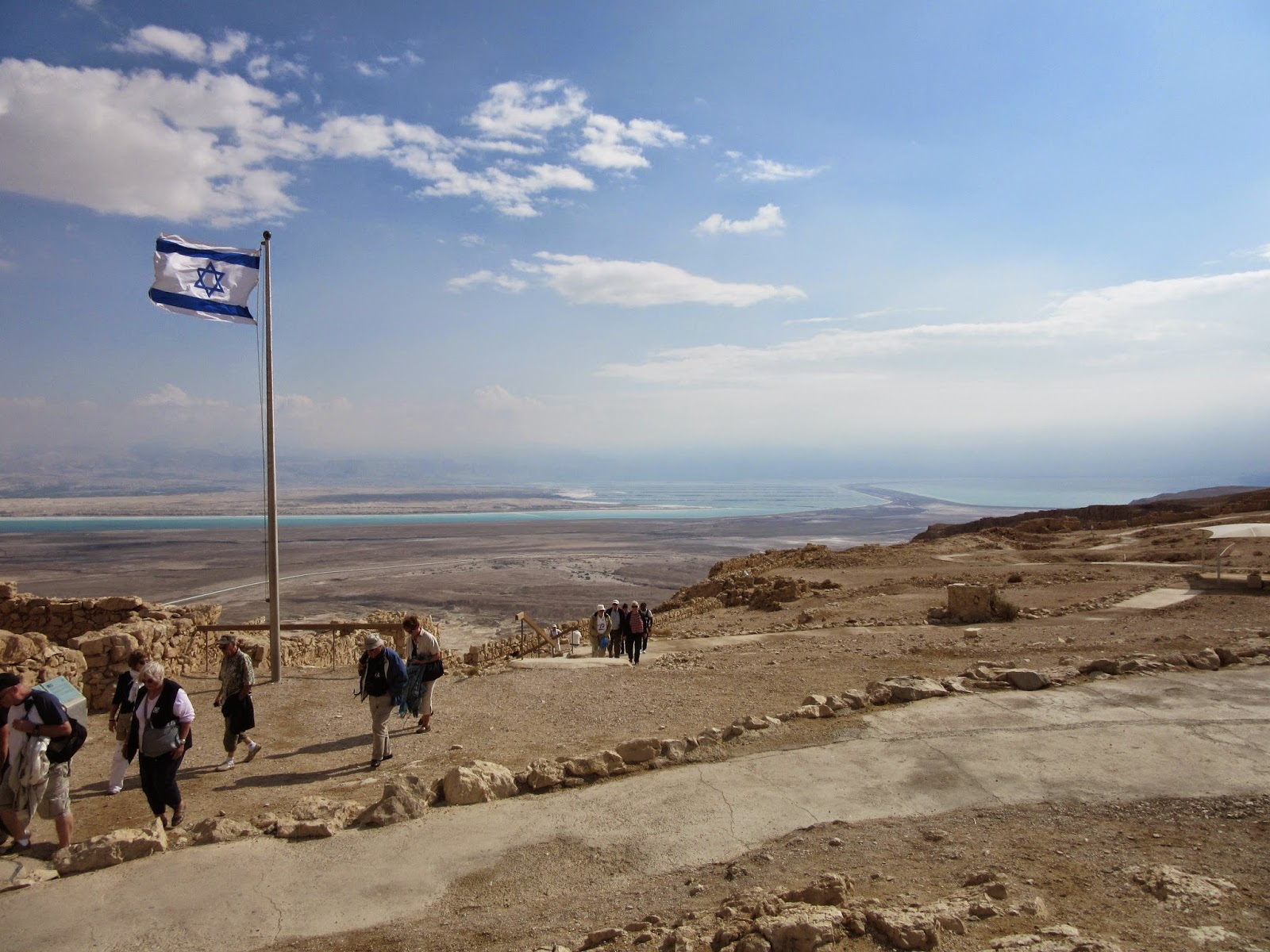
We carried on and it after a little while I got my first glimpse of Masada, a high plateau sitting alone and not joined to the rest of the mountains around it. It really is quite the place and I don't think my photos do it justice, so I shall do my best to describe it. We drove into the site from the east side, (I've just looked at the map), and from here we could take the cable car, or, if we felt really adventurous, we could walk up the Snake Path. They say it is nice to do that in the early morning so that you get to the top to see the sunrise, we were a little late for that, and it is quite the walk so we took the cable car to the top.


In this photo, you can clearly see the snaking path that would have taken us up. When we got to the top, the views are incredible. I had looked out of the windows of the cable car and got a little dizzy, I'm not great with heights, but I really did want to see Masada. I don't know how familiar you all are with the story of Masada, but it was here that King Herod built two palaces, the most impressive of which would be the northern palace. He also built a western palace.

I have to say that it was all very impressive and you had to wonder how they got all this stone up here in the first place, not the mention columns etc,. The photo above was one of the administrative buildings, and there was some beautifully decorated plasterwork in the corner. The black line in the wall is to show what they originally found upon excavation. Anything above that was added after they excavated the site to give an idea of what the building would have looked like. I found that very interesting and it did give a better sense of size and scale. The whole site was enormous.

This was a storeroom, one of several built side by side, but this one had been cleared so you could get a feel for the size, the others were still full of rubble
Now, the story of Masada is very complex and I will try not to bore you too much, but I have cribbed a bit from the guidebook I got there as I would never remember it all myself! But the events of 74CE were written about by a Jewish historian, Joseph ben Mattathias who had links to Rome and was known as Josephus Flavius, it is all very complicated and it is probably best to research it for yourselves. But it would appear that Josephus wrote a book, "Wars of the Jews", which described events leading up to what happened on Masada, and he wrote it to discourage others from rebelling against Rome.
Masada is strategically very important, it is as I said on a plateau of it's own and the view over the area is also important, and a desert fortress would have been a necessity. To cut a long and complicated story short, Herod eventually dies and Masada passes to his son, totally incompetent by all accounts, and he was eventually deposed and a Roman garrison installed, Are you with me so far?
A full rebellion eventually erupted as the Romans were not sensitive to "Jewish religious sensibilities", I quote my guide book here. So the rebellion continues with emancipation from Rome being at the core. There was trouble in Jerusalem, and a small group then flees to Masada led by Eleazar ben Yair. So more fighting and eventually the Romans get to Masada.
The rebels are safely ensconced on Masada, and have food and water. The Romans are left to wonder how they are going to attack, and build a ramp on the western approach to Masada. They had built encampments at the base of Masada, and once the ramp was up, were able to fire into the rebel stronghold. However, the rebels have built a new wall and so the soldiers are told to burn it down, but the wind changed and the Romans were in danger of losing their own encampments.
It was that night that Eleazar ben Yair called everyone together and made an impassioned plea to them. They would not under any circumstance acquiesce to Rome and become slaves, so that left only one option, they would all rather die. So, lots were drawn to see who would carry out this deed.
Ten men were chosen of which Eleazar ben Yair was one, and killed everyone on Masada and then themselves or each other. When the Romans finally breached the walls the following day, they were met by a scene which I am sure, they found unbelievable. There were only two women and five children who survived by hiding in water conduits, so they emerged and were able to tell the Romans what had happened.
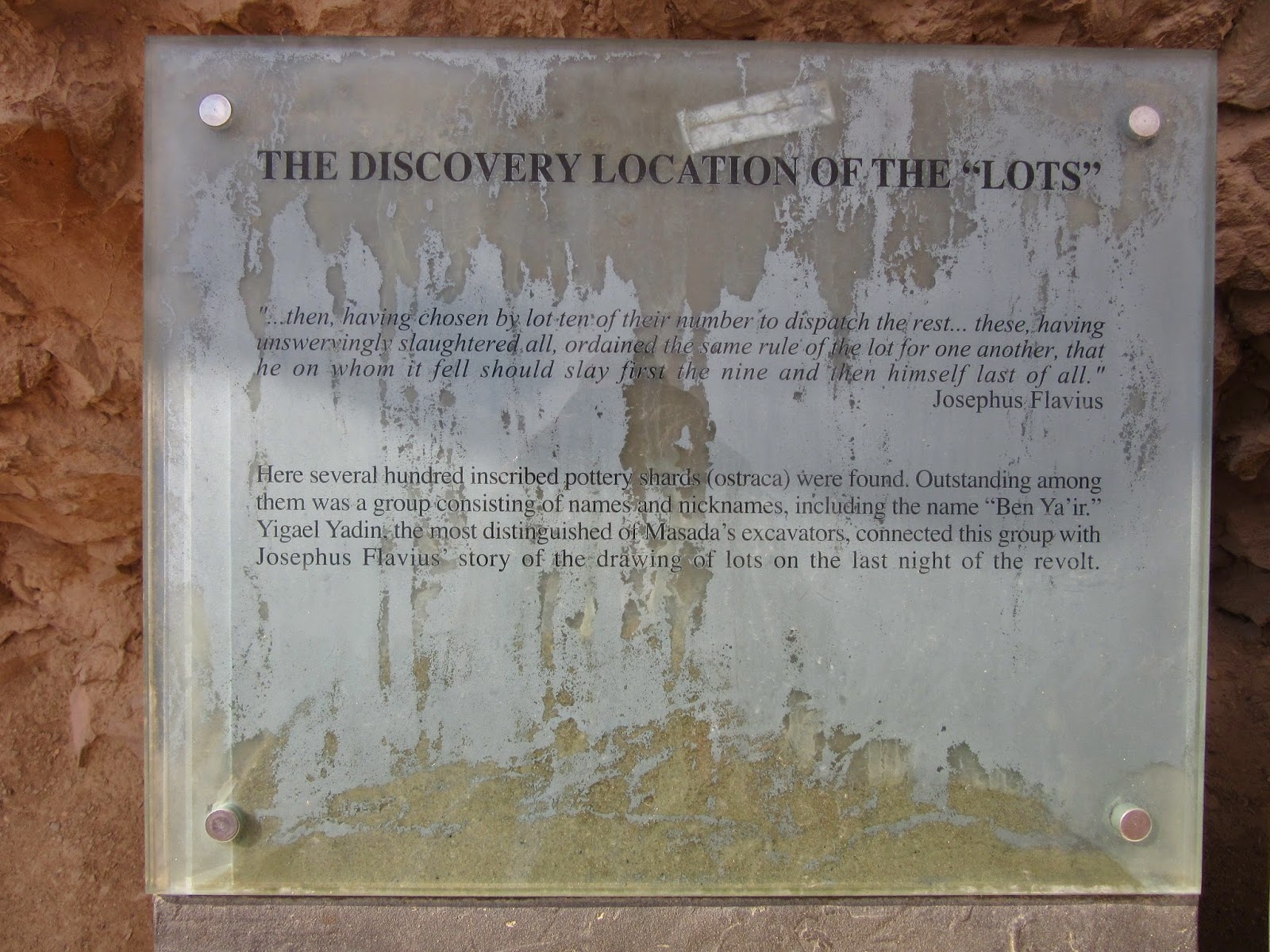

The stones with names on which are presumed to be the lots that were drawn to see who was going to do the killings

Looking down on one of the levels of Herod's northern palace

This model shows what it would have looked like

One of the encampments which was on the western side.

The stairs down to the lower level of Herod's palace

Wall frescoes and columns


We sat and rested here for a little and ate some fruit and drank water. It was actually the perfect day to be doing this as it was breezy and although sunny, not too hot. In the summer I am sure it must be incredibly hot as there is no shade whatsoever.
We carried on and went into the ruin of the synagogue, there were several tour groups here with their guides, and we had a quick look when Yemima went into a room at the back of the synagogue and there, sitting behind a glass window was a scribe writing the Torah with a quill pen. I couldn't quite believe my eyes that I would ever see something like this. I watched him work in fascination as he copied the script from a master copy I suppose, and when he reached the end of a line, he would fold that line on the one he was following so he could copy the next line. Yemima told him I was from Canada, and he asked my name. He took a small piece of paper out of a jar and wrote my name in Hebrew, but changed the last letter, I will have to wait for clarification as to why as I can't remember but I will let you know when I get it. It was fascinating to watch and I don't know how he could chat and not make a mistake, I do know that if a mistake is made while writing the Torah it cannot be changed and the whole thing has to be destroyed. While I watched him work, I could here the tour groups outside, one guide even told her group, " oh there's only someone writing in there.." almost in a bored way and as if it was nothing really very special. It made me glad that I wasn't with a group as I think they miss so much.


My name in Hebrew. I have this very safe as I want it laminated so that I can use it, I will also scan it so that I can use it in my work.


An explanation of the breaching point and the ramp on the western approach


One of the many Artisan's workshops


Again the mosaic floors were breathtaking, and I really enjoyed looking at them we spent a lot of time there and then took the cable car back down the mountain. Once at the bottom, we went into an excellent museum which explained in more detail what it was like to live there, and also had the lots which were drawn in a case.


The sun was beginning to go down now, so it was time to head home. I was moving on again tomorrow and had another great day ahead of me........


